Spanish Arabian Horse - Characteristics, History and Sale
Spanish Arabian is a popular kind of Arabian horse breed. Spanish Arabian comes across breeding with Arabian and Spanish combination. In this article, we will discuss about Spanish Arabian horse in details.
 |
| image source |
There are several types of Arabs that come down through 5 different lines of females: Kuhaylan El Adjus, Siglavy, Habdan, Hamdani and Obajan. Each of these types has distinct physical characteristics. One of the most popular horse breeds in Arab America.
The influence of the Arabian horse has long been a part of the traditions of horse racing in Spain and is one of the leading Andalusian breeds in the country. The breeding of pure Arabian horses began with the horses originally imported for the second Queen Isabella, though these lines did not survive today.
 |
| image source |
Spanish Arabian Origin:
About six thousand years ago, the warriors of the Iberian Peninsula were established as advanced horsemen.
At times it is well-documented that the Iberian cavalry had a reputation as an effective and fearless enemy, much of their success because of their fine arrows.
These types of battleships consist of quick starts, stops and pirouettes with individual horse charges, and then a combination of retreat and re-invasion. A form of riding that was made possible by the use of very agile horses, carb beats and point strops.
In the 7th century, during the reign of the Visigoths, Muslims invaded the Iberian Peninsula and occupied it until the end of the fifteenth century. During the occupation, much has been written about the influence of barbs and Arabian horses in the Iberian stock.
 |
| image source |
Because of their own belief in the quality of their war mares, the horse's condition has probably stabilized since this time. The marshes are well respected in Spain's Arab breeding program and throughout Europe. In the United States, there is more emphasis on them and their tail females (the main saree of the line below the line) than on the stallion and sire line.
Originally all of Spain's breeding was in the hands of the Royal Family and the Nobles. Since the various kingdoms united through both war and marriage eventually formed a central government, the "kingdom" adopted the selection and improvement of marine reproduction.
Mandatory military service began in the 1700s with a minimum of 8 years. It often leads to a lifetime career with further promotion in ministry. The officers were not only attached to their mounts; Their lives depend on them.
All horses were considered war equipment and their breeding came under the Defense Department. In the Middle Ages the Iberian War Horse and its crosses were famous throughout Europe. It was huge, impressive and ingenious.
With the heavier draft type bloodlines added, it became much more complicated as a horse to travel at any length or speed. Lots of Roman heads have been developed, heavy thick necks and wide strong hindquarters.
They were a terrifying sight that intimidated villagers in small towns in Europe. But as firearms evolved and armor lightened, such horses were too heavy and slow to build up resistance against any warrior mounted on the Orient's horses in their small light and faster desert.
By 1847, the young 16-year-old Queen II Isabel liked the more fascinating better-tempered Mt.
 |
| image source |
He kept a record of his personal stock and concentrated on the breeding of purebred Arabs. He sent a procurement commission into the desert to look for the best bloodline to improve and improve the declining horse population. Thus the first Spanish registry and study-book was started in 1847 and remains today the oldest established registrar of Arabs.
His son King Alfonso continued the trend and imported fine bloodied Arabs from France in 1884-1885. By 1893, a Royal Order laid the foundation for the breeding of Arab horses by the state and established the Yeguda Militar at Cordoba in Moratla. Very little purity was produced from the previous imports because the purpose was to improve cross-blood Iberian warhorse and promote all Equine stocks in Spain.
Spanish Arabian modern day breeding
By 5, the ferocious breeding of purebred Arabs had begun for the Yeguda militarists to buy the most prolific breeding stock in Syria's Mesopotamia and the Arabian Desert.
According to the 8 diary, kept by Captain Luis Azpitide Morrow, 'en Basca del Cablo Arabe', they were looking for refinements, good riding mounts, height (15 hours h minimum) and had an age limit of more than 8-10 years.
There was mental stress so the horses bought could know the stamina. Hundreds of horses were looked at and only bought 23 heads. In 186, the Purchase Commission sent to Poland returned the same number.
However it was the imports of 1908 and 1912, again from the desert and Poland, that are the most significant in today's pages. The type that Hamdani Cimri liked was the riding and its tranquil nature and the Saklaway style were notable for its refinement, beauty and speed. Also found were several Maggie Sambelli, Kohilan Adjuz, Kohilan Rodan, and a few Dahmon stallions, most notably Ursus of Poland and his father's sister Damietta.

Spanish Arabian closed gene pool
For almost 100 years since then, Jean has been involved with very few outside bloodlines outside the pool. As a private breeder, the imports of Cristobal Colonel Aguilera, XV Duke de Verguerra from England between 1926 and 1930 had a great impact.
In the years 1935 and 1936, she also bought all the female stock from the heirs of the Marquis de Domac Stud. He was killed in the Spanish Civil War in November 36, leaving no direct heirs.
His Bloodstock included most of Crabbett's five daughters, the Skowroneck, and had such a reputation that it was collected by the military for preservation. Unfortunately the stallion that died was the stallion king but all the rest were sent to their broodmare farm in Cordoba.
Most of the mares were branded and thus identified. Veragua was identified as a genuine Arab of some varieties, including some old filizers, but they were required to be renamed with the 'Vera' prefix because all papers were wasted.
They were kept by the military. The youngest fils were sold, originally to Duke's nephew Marxa de Avella, whose breeding program is still thriving.
 |
| image source |
Then and still, the Yeguda Militar puts the band on a broodmare of 20-30 heads and sells the surplus to private breeders. They keep about 100 stallions which are stored in various remote stallion deposits throughout the country for annual breeders' use and local stock for very nominal remuneration.
Are eligible to join. At the age of four, these foals are included in the original study book. Grades mares or half Arab marias will receive half the paperwork for their fruit which is not included in the Spanish study book. All stallions of reproductive age must be certified by the military commission's action caballer for use during study and designated for private or public use.
Although the number increased from 328 in Spain in the early 1960s to about 13,000 registered Arabs in Spain today (2006), Spanish Arabs and Spanish-related Arabs in the United States represent less than 5% of the total Arab population.
Due to their rarity and minimal numbers, this bloodline is mainly used as a breeding stock. Some of these horses have appeared in public shortly after the Spanish Arabs and their associated crosses with an extremely high percentage of winning at shows and events.
In 1834 James and Edna Draper became acquainted with the United States with six imports, including the Foundation Mars, Mecca and Memphis, with no major additions until the Charles Stein import in 1865.
As a result, 26 more Spanish were brought to the United States, some like Eurio Barich de Washo, the leading sire of 104 pure Spanish foals, and 446 sires, with less than 27 national wins.
By 1973, Spain's imports were made more effective by the recognition of the Veragua horses in their studybook. The late 70s and 1980s saw a wave of imports from Spain, most of which were mainly used for exotic breeding.
Global Impact
Leading names such as the top sire * AN owner and * Berich de Washoe, Triple National Champion horse Ava Hamir, 1/4 Spanish Stallion Triple National Western Pleasure Champion CA Hermoso and Spanish half stallions * El Shakalan and Magnum Psyche. As the old imported horses continue to move, new blood is being discovered and re-imports into the new millennium begin.
The previous closed gene pool and the heavy-line breeding up to the 1970s remain quite distinct from the Spanish Arabian varieties. In breeder terms, they tend to breed true. Due to the import of external bloodlines from Spain since the 1970s, the term Classical Spanish has been used to trace their descent into the horses of Spanish Arabian that was in the Spanish study book before 1970, with four grandparents identified on all lines.
Spanish Foundation stock, whose original Arabic pedigrees have been kept in the 'Golden Books'. In Madrid, Spain. Until the 25th of 2007, the ECCA (Associazion Espanola de Cordaurs de Cabalos Arbes), the National Breeders Association, is the sole registered Arabian Arabs.
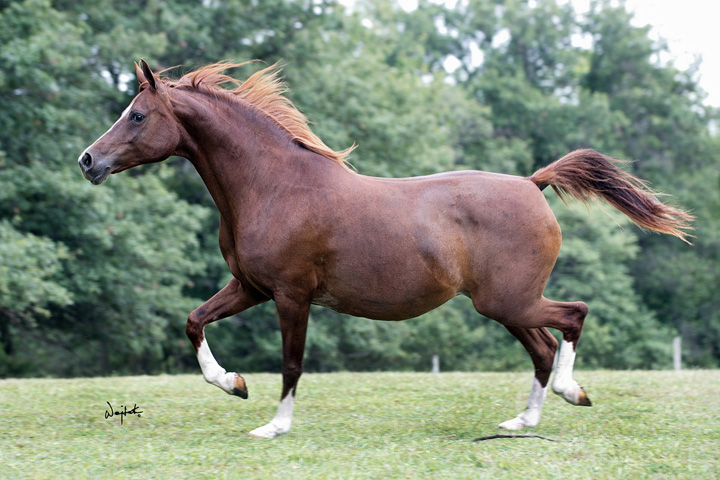
This effort and the breeding selected by Spain's Yeguda militia and their private breeders have made the Spanish Arabian a versatile athletic horse with a willing and gentle temper. Minimally smooth, well-angled with a gentle neck, it is known for its large beautiful dark eyes, thick bones, short and powerful joints, high-tail cars and its training.
The genetic effects of this tight gene pool have been great as outcrops as Spanish and Spanish-related Arabian have won numerous championships across North and South America, Europe and the Middle East. This Bloodline has many dedicated owners and audiences worldwide.
Join them and experience Spanish Arabian for their unique nature, elegance and quality performance.
This type of Arabian horse is already declining its population, and now the Arabian breed has only 1.5% of the entire population. These are very smooth running horses which is why they are great for long rides. Some of its features are face and tail which are curved and have a good and quiet personality. Spanish Arabian horses also have a small amount of energy compared to Egyptian Arabs, making them suitable for a good family pet.
Color
- Available in some shades of white, gray, brown
Height
- 14. 5 hands up to 15 hands
With all the information described above, you now have an idea of what the different types of Arabian horses are. It simply shows that there are widespread Arabian horse breeds that can be used for a variety of purposes. You should also know that they are more than just the type and you know. If you want to know other types of Arabian horses, you can ask a veterinarian or even a professional veterinarian.
Hope this article on Spanish Arabian horse breed was found useful to you.
The previous closed gene pool and the heavy-line breeding up to the 1970s remain quite distinct from the Spanish Arabian varieties. In breeder terms, they tend to breed true. Due to the import of external bloodlines from Spain since the 1970s, the term Classical Spanish has been used to trace their descent into the horses of Spanish Arabian that was in the Spanish study book before 1970, with four grandparents identified on all lines.
Spanish Foundation stock, whose original Arabic pedigrees have been kept in the 'Golden Books'. In Madrid, Spain. Until the 25th of 2007, the ECCA (Associazion Espanola de Cordaurs de Cabalos Arbes), the National Breeders Association, is the sole registered Arabian Arabs.
This effort and the breeding selected by Spain's Yeguda militia and their private breeders have made the Spanish Arabian a versatile athletic horse with a willing and gentle temper. Minimally smooth, well-angled with a gentle neck, it is known for its large beautiful dark eyes, thick bones, short and powerful joints, high-tail cars and its training.
The genetic effects of this tight gene pool have been great as outcrops as Spanish and Spanish-related Arabian have won numerous championships across North and South America, Europe and the Middle East. This Bloodline has many dedicated owners and audiences worldwide.
Join them and experience Spanish Arabian for their unique nature, elegance and quality performance.
 |
| image source |
Spanish Arabian Description
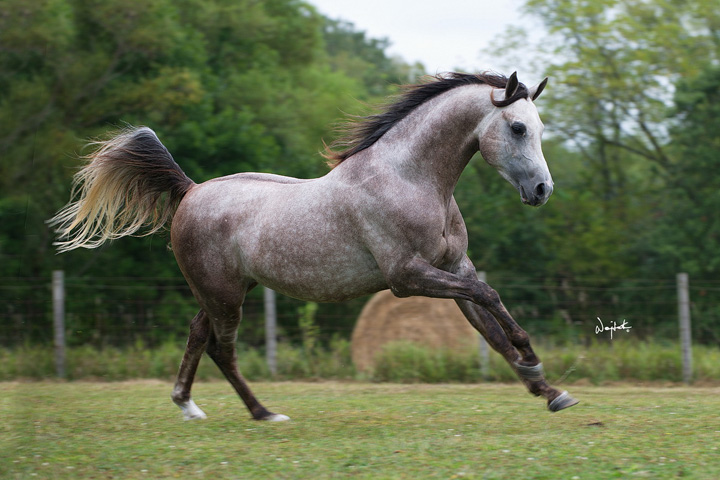
This type of Arabian horse is already declining its population, and now the Arabian breed has only 1.5% of the entire population. These are very smooth running horses which is why they are great for long rides. Some of its features are face and tail which are curved and have a good and quiet personality. Spanish Arabian horses also have a small amount of energy compared to Egyptian Arabs, making them suitable for a good family pet.
Color
- Available in some shades of white, gray, brown
Height
- 14. 5 hands up to 15 hands
With all the information described above, you now have an idea of what the different types of Arabian horses are. It simply shows that there are widespread Arabian horse breeds that can be used for a variety of purposes. You should also know that they are more than just the type and you know. If you want to know other types of Arabian horses, you can ask a veterinarian or even a professional veterinarian.
Hope this article on Spanish Arabian horse breed was found useful to you.

Comments
Post a Comment